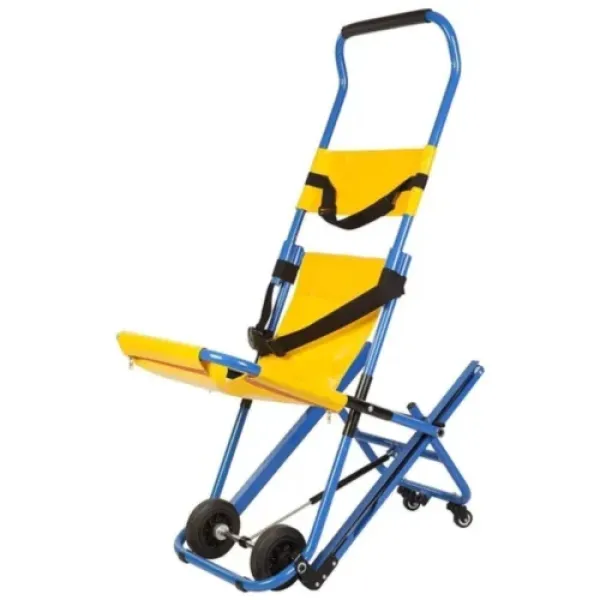
Evacuation and Stair Chair Manufacturers in Chennai
Evacuation and stair chairs are built to assist healthcare personnel, emergency personnel, and trained carers to move patients safely where conventional wheelchairs or stretchers are not practical. They are especially useful in buildings with staircases, narrow corridors, limited access or multiple floors, during emergency evacuations.
Selecting the right evacuation equipment is an essential component of patient safety planning for emergency preparedness within a healthcare facility. An evacuation and stair chair can be a convenient way to move patients that are not able to walk by themselves and enable trained personnel to move them through stairways and other difficult areas.
Evacuation and Stair Chair Manufacturers in Chennai can be chosen based on patient needs, building layout, evacuation procedures and operational needs.
Evacuation and Stair Chair Suppliers in India
Hospitals and healthcare facilities may require specialised evacuation equipment depending on their building design and emergency-management requirements. Evacuation and stair chairs are particularly useful where patients need to be moved through staircases during an emergency and the use of a conventional stretcher or wheelchair may be difficult.
Healthcare facilities need to look at construction, patient-support features, manoeuvrability, storage requirement, staircase configuration and ease of operation by trained personnel while procuring an evacuation and stair chair in India.
We Evacuation and Stair Chair Suppliers in India provides healthcare equipment for various institutional needs, allowing hospitals and other healthcare facilities to choose a product that fits their operational and patient-care needs.
Evacuation and Stair Chair Exporters in India
Evacuation And Stair Chairs Exporters In India are also employed in healthcare and institutional settings where emergency preparedness is a primary concern. Because they are smaller, they may be appropriate for use in areas where it is difficult to store or handle larger patient-moving devices.
We is a healthcare equipment provider in India catering to requirements across different healthcare establishments. Prior to selecting an appropriate evacuation and stair chair, facilities can evaluate their evacuation procedures, building access, patient population, and emergency response needs.
Types of Evacuation and Stair Chair
Evacuation chairs and stair chairs differ in construction, configuration, patient-support features, and mode of movement. In choosing these chairs, the usual considerations are:
- Manual Evacuation Chairs: Suitable for trained personnel to carry patients manually in emergency situations.
- Stair Evacuation Chairs: These are specially designed to help patients go down staircases.
- Foldable Evacuation Chairs: Compact size, easy to store when not in use, can be folded.
- Tracked Evacuation Chairs: Some chairs have tracks or similar devices to assist trained operators in moving a patient downstairs.
- Emergency Transfer Chairs: These are designed for use in emergency situations in corridors, exits and other areas.
The specific setup required will depend on the healthcare facility, the building design, the evacuation plan and the patient needs.
What Is an Evacuation and Stair Chair Used For?
An evacuation and stair chair is a device that is used to assist trained personnel in moving patients who are not able to walk on their own in an emergency evacuation. This can be particularly helpful when patients need to be moved through stairwells or tight spaces where normal patient transfer equipment may not be feasible.
These chairs can assist with emergency transfers from patient rooms, treatment areas, wards, offices or other areas of a health care facility to a designated safe location. Their small size could also make them useful in places where space and access are limited.
However, evacuation chairs should be used in accordance with the manufacturer’s instructions and the emergency procedures of the facility. Staff should be appropriately trained prior to using the equipment for patient evacuation.
Which Evacuation and Stair Chair Is Suitable for Hospitals?
The selection of the right evacuation and stair chair for a hospital depends on a number of factors, including the hospital’s structural design, the layout of staircases, patient needs, storage space, and the protocols for emergency evacuation.
Hospitals should take into account:
- Patient Weight and Mobility Needs
- Staircases width and arrangement
- Ease of movement and chair dimensions
- Patient support and restraint functions
- Storage and accessibility made easy
- Build and Strength
- Number of trained operators
- Compatible with the hospital’s emergency evacuation plan.
Why Choose Unipro for Evacuation and Stair Chair?
Selecting the appropriate equipment for the transfer of emergency patients involves both patient safety and the practical needs of healthcare staff. We provides medical equipment to hospitals, nursing homes, clinics, healthcare institutions and other medical facilities.
Facilities probably look to We first for their evacuation and stair chair needs because:
- Healthcare-focused solutions: Products are designed for healthcare and patient-care environments.
- Institutional requirements: Equipment may be considered for hospitals, clinics, nursing homes and other healthcare establishments.
- Facilities: Should evaluate their own evacuation and patient-transfer needs prior to selecting suitable equipment.
- Practical design considerations: Storage, accessibility, manoeuvrability and operational requirements can be used to assess evacuation equipment.
- Pan-India Supply: Serves healthcare establishments across the country.
How to Choose an Evacuation and Stair Chair for a New Hospital?
When a new hospital is being built, the safety of the building, the transfer of patients and the emergency evacuation equipment should be considered together. The right evacuation and stair chair should fit with the physical layout of the hospital and the patients it serves.
Begin by evaluating the hospital’s staircases, hallways, exits, patient rooms, emergency access routes, and locations where conventional equipment might have limited mobility. Then hospitals should consider the kinds of patients who might need help, such as patients with limited mobility or those who cannot use stairs on their own.
Other considerations are weight capacity of the chair, patient support features, storage location, ease of deployment, manoeuvrability and operator requirements. Staff training is equally important because evacuation equipment needs to be used correctly during an emergency.
| Category | Evacuation and Stair Chair |
|---|---|
| Location Support | Chennai & Nationwide |
| Availability | In Stock / Contact for Delivery |