ICU Equipment Manufacturers in Chennai
ICU equipment is essential for intensive care units where critically ill patients require ongoing surveillance, supportive care and access to special medical equipment. Sometimes, hospitals setting up or upgrading an intensive care unit may need several types of equipment instead of one product. Specific requirements will depend on whether the facility is developing a general ICU, a specialised critical-care unit or some other type of intensive-care setting.
We ICU Equipment Manufacturers in Chennai supplies healthcare equipment for hospitals, clinics, nursing homes, and other healthcare establishments. When planning ICU equipment procurement, hospitals need to consider patient requirements, ICU layout, available space, electrical and utility connections, equipment compatibility, ease of operation, maintenance, and the specific clinical applications for which each product will be used.
ICU Equipment Suppliers in India
Sometimes, hospitals setting up or upgrading an intensive care unit may need several types of equipment instead of one product. Specific requirements will depend on whether the facility is developing a general ICU, a specialised critical-care unit or some other type of intensive-care setting.
ICU Equipment Suppliers in India is one of the leading suppliers of healthcare equipment in Chennai and in India for various healthcare projects. For procurement of ICU equipment in India, the procurement team should keep in mind:
- ICU type & capacity
- Patient bed count
- Patient monitoring equipment required
- Requirements for respiratory and oxygen therapy
- Emergency and resuscitation equipment.
- Positioning and mobility needs of the patient
- Floor and bedside space available.
For new hospitals and bigger projects, quantities, configurations, sizes and specifications of equipment should be planned based on the proposed ICU layout and clinical needs.
ICU Equipment Exporters in India
Indian healthcare equipment suppliers and exporters can support ICU projects requiring equipment for hospitals, medical institutions, nursing homes, and other critical-care facilities. ICU equipment may include patient-care furniture, monitoring systems, respiratory-care equipment, emergency equipment, and other products required within an intensive-care environment.
For export and institutional procurement, the exact product specifications, certifications, electrical requirements, packaging, documentation, and destination-country regulations should be verified before shipment. ICU Equipment Exporters in India can support healthcare equipment requirements based on the specifications and scope of the project.
Types of ICU Equipment
Generally, an ICU needs a combination of equipment, since critically ill patients may require monitoring, respiratory support, emergency intervention, positioning, and continuous nursing care.
ICU equipment can be broadly classified as follows:
- ICU beds: Beds adjustable for positioning and access for intensive care patients.
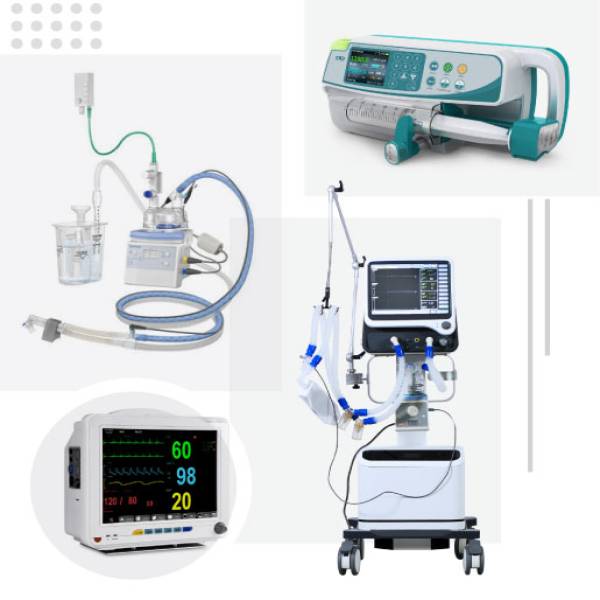
- Patient monitors: Used to monitor selected physiological parameters per device configuration.
- Ventilators: Provide mechanical respiratory support when clinically indicated.
- Syringe pumps and infusion pumps: Used to administer controlled quantities of prescribed fluids or medications.
- Defibrillators: For use by trained healthcare professionals for appropriate emergency cardiac interventions.
- Suction equipment: Use if controlled suction is clinically indicated.
- Oxygen therapy equipment: Equipment such as oxygen concentrators and other oxygen-delivery accessories depending on the oxygen infrastructure of the facility.
The specific ICU equipment list should be developed according to the clinical protocols of the hospital, number of patients, type of ICU and healthcare requirements that are relevant.
What Is ICU Equipment Used For?
ICU equipment is used to support the assessment, monitoring, treatment, positioning, and ongoing care of critically ill patients. Different devices perform different functions, and no single piece of equipment provides all ICU requirements.
Depending on the equipment category, ICU products may be used for:
- Continuous or periodic patient monitoring
- Respiratory support
- Administration of prescribed medication and fluids
- Oxygen therapy
- Emergency and resuscitation procedures
- Patient positioning
- Patient transfer and mobility
- Bedside nursing care
- Pressure-management requirements
- Recovery and critical-care support
Because ICU patients can have complex medical needs, equipment should be selected and operated by appropriately trained healthcare professionals according to clinical protocols and manufacturer instructions.
Which ICU Equipment Is Suitable for Hospitals?
What ICU equipment should a hospital have? The type of intensive-care unit, number of beds, patient profile, clinical services and infrastructure available influence this. A new hospital may have to plan the equipment package along with ICU beds, medical-gas systems, electrical infrastructure, monitoring requirements and emergency-response arrangements.
- ICU equipment: what hospitals need to know before buying
- Clinical prerequisites: The ICU is intended to support patients and care of the following type.
- Bed capacity: assess the equipment needed for individual patient stations and shared ICU areas.
- Needs Monitoring: Choose the monitoring equipment depending on the parameters to be monitored.
- Respiratory support: Determine need for ventilators, oxygen-delivery equipment, suction systems and associated accessories.
The hospital should develop an equipment schedule prior to acquisition to ensure that each ICU area has the equipment appropriate for its intended use.
Why Choose Unipro for ICU Equipment?
We provides medical equipment to hospitals and medical facilities and can assist with procurement for intensive care settings. For new and existing facilities, a coordinated approach to sourcing equipment can be helpful. ICU projects often involve multiple products, quantities, specifications and installation considerations.
Healthcare facilities may partner with We for:
- Procurement of ICU Equipment
- Hospital and critical care project needs
- Equipment Buying All Over India
- Individual and collective requirements
- Categories of Equipment for Patient-Care Areas
- Product Specification Assistance
- Equipment requirements of new hospital projects
- By Application Sourcing of medical equipment
The specific equipment, model, configuration, availability and technical specifications to be checked with We according to the project's requirements.
How to Choose ICU Equipment for a New Hospital?
Setting up an ICU requires careful planning because equipment must work within the clinical, spatial, electrical, and operational requirements of the unit. A practical procurement process can begin with the following checklist:
- Define the ICU type: Determine whether the facility requires a general ICU or a specialised critical-care environment.
- Calculate bed capacity: Establish the number of patient stations and identify equipment required for each bed.
- Create equipment list: Separate critical patient care, monitoring and respiratory emergency and support equipments.
- Verify the technical specifications: Compare specifications based on the intended clinical application rather than selecting equipment based on price or brand.
- Check the infrastructure: Make sure that the electrical supply, medical gases, space, ventilation and other infrastructure are available to support the equipment.
- Think about the flow: Health care professionals should have adequate access to the patient and surrounding equipment.
Hospital shall prepare a detailed schedule of equipment giving product names, quantities, specifications required and the location in which it is to be used for bulk orders.
| Category | ICU Equipment |
|---|---|
| Location Support | Chennai & Nationwide |
| Availability | In Stock / Contact for Delivery |